Thursday, February 22, 2024

Tools: The Choke Chain


Recently, it was brought to my attention that I do not have a 'tools' article about the Choke Chain.  I have purposely avoided talking too much about this little piece of equipment, because of my personal feelings towards its application in uneducated hands.  That's not fair to you, dear Reader.  

While not my 'go to' usually, these simple little collars have been around forever.  They are met with almost as much controversy as the electronic correction collars, or the prong collar. They get lumped together with all the other "adverse" training tools, but they do still have a place in the training world.  As with any tool, one must familiarize themselves with the proper use and application of said tool, if one expects to be pleased with the end result.  And as with any tool, misuse can result in injury.

The basic rule to remember here, is the smaller the chain-link, the more it can hurt.  Obviously, if this is your tool of choice, be reasonable in your link choices; a 120 lb dog should not be on a chain that is too fine to hold him, nor should that little Chihuahua be rockin' big gold links for control.....no matter how cool he looks in it.


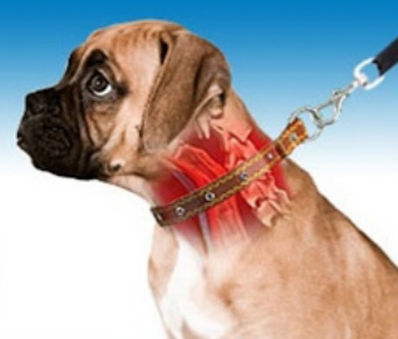
As you can see in this illustration, allowing too much pressure on a young dog's throat, no matter what kind of collar you use can cause some damage.

Please do not choke chain a young or fragile dog.  Most canines throats/trachea and cervical spines are not developed or strong enough to take a strong 'snap' or 'pop' correction, before the age of 6 months.  Breeds that are prone to spine issues, such as Dachshunds, or French Bulldogs, should most likely not be trained with this tool.  If you already have one on your dog, and all you hear is that "hnghngh--hack/cough" sound as your dog Still pulls you, it is being used incorrectly, and you are building scar tissue in his throat. Or worse, you are headed for a condition known as "Collapsing Trachea," or deficiencies and complications with your dog's thyroid glands.  Please note, these conditions can also be caused by genetics, or other factors as well; in no way do I 'blame the chain' for all throat damage or conditions.

Do Not tie your dog out in a choke chain!  If he gets it caught or hung up on something, he can strangle and die.  If you must use a tie-out, a Martingale with a quick release is a much safer option--Here's a link to our article on them, if you want more information on this wonderful little tool: http://rosedogtraining.blogspot.com/2014/06/tools-you-should-use-martingale-collar.html

If you have decided the choke chain is the way to go:  Let's make sure you at least know the basic How To of Fit and Function.

To properly fit a choke chain, measure your dog's skull at its widest point, and then add 2".  This will give you enough clearance for most ears, but not so much extra chain, that you'd find yourself with too much extra chain at the end of your leash when attached.  We want the chain's action to be quick:  Too much extra chain can slow this down, and decrease the effectiveness of the correction.  Should you have a breed with Huge ears (think Bloodhound), adding 3 inches to your measurement will be More than enough.

The chain should fit high on the neck, directly behind the dogs ears, and just under his jaw, where it meets his throat.  His trachea is closest to the surface at this point, which means your correction will be most uncomfortable here, thus making it most effective.  

If the dog is to walk on your left side, the chain should look like a letter "P" when you put it on him.

For a dog on your Left, the chain should form a letter "P"

 If you walk your dog on the right, the chain should look like a letter "Q".  

If you walk your dog on your Right, place the chain on the dog so it resembles a "Q."

While this may not seem too important, it actually can change the way the action of the chain responds when you snap it.  

Should the chain be either too long, or is not placed/used high on the neck, the correction becomes less impactful.  The lower on the neck the chain slips, the more your dog's trachea is protected by muscle and fur, and dewlaps...This means that you will also have to 'pop' him with more force to get his attention.  

A choke chain that rides low on the neck Will eventually be acceptable, but by the time you are allowing that, your dog should have been trained with proper placement (high behind the ears), and no longer needs a "real" correction to respond or respect the leash.  At that point, the dog is responding to the lightest jiggle of the collar, and he knows that sound (the chain slipping against itself) is a precursor to a 'pop' or 'snap' correction, and will correct himself, way before you need to actually snap him.

A chain that is too long, or placed incorrectly, can snag and pinch ear flaps, or loose skin when suddenly yanked, or 'popped.'  

Have you ever watched a dog show?    
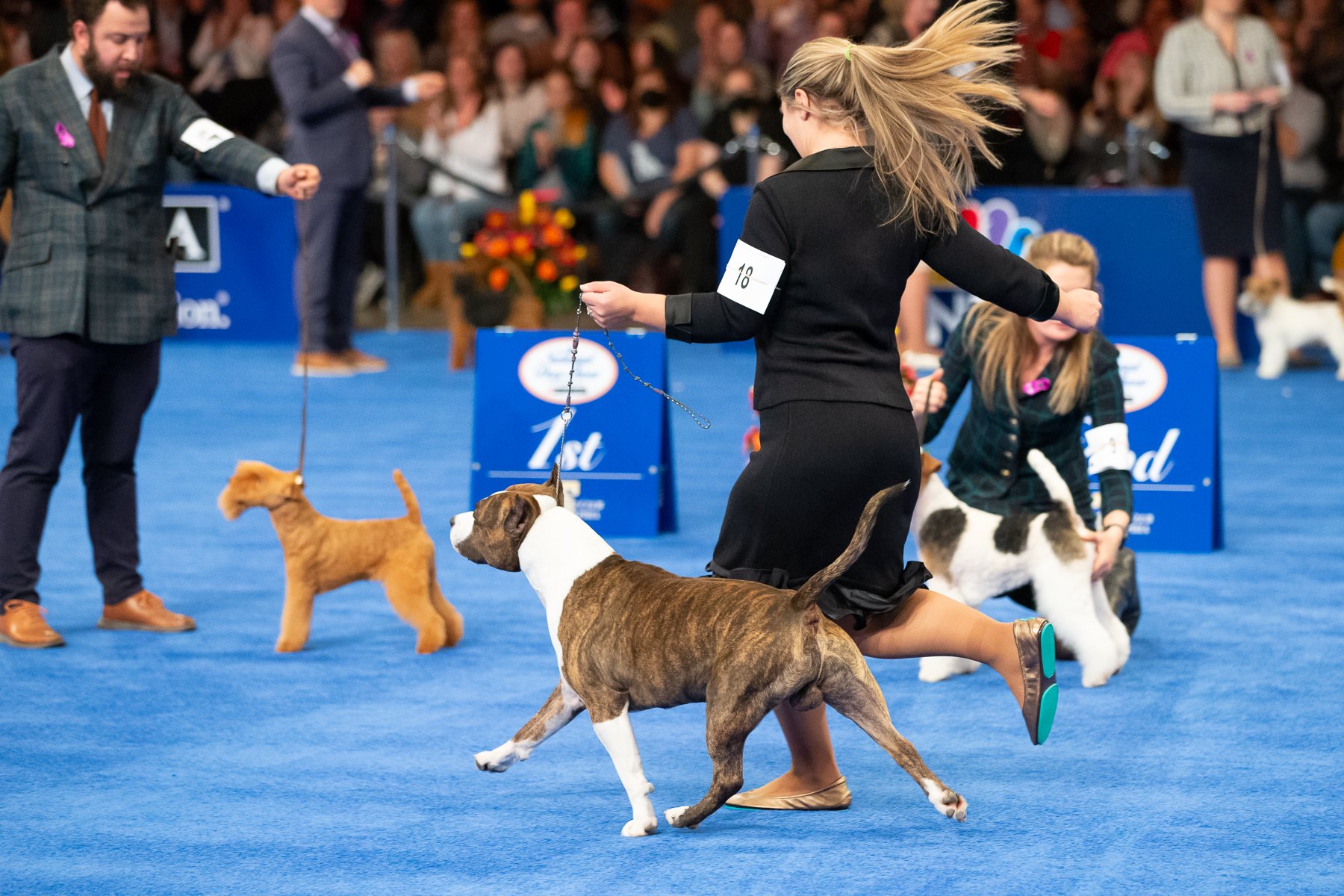
Think about how those handlers hold the leash when they are showing the dog off as they jog around the ring.  That tiny little cord, or delicate chain is right up on that neck, keeping that dog's head off the ground, and those toes on their tips....Using a choke chain at first, will feel like you are trying to do a dog show.

This does not mean that you are half-choking the dog all the time as you walk.  Allowing too much tension (be it from the dog pulling it tight all the time, or from your attempting to hold the dog back rather than properly correct him), can also cause blood vessels in the dogs eyes to break, or raise the pressure in the actual eyeball to such a degree that the eye may be damaged or lost entirely---I've seen it, it's not pretty; nor is it 'cheap' to fix when you take him to the vet.  This ocular injury can occur with hard-pullers on a collar of any kind, so if you are noticing your pup seems to have red eyes after a good pull (some people call it walking), you may want to reevaluate the tools you have chosen...Or try to alter the way in which you are using it.

So you've gotten the appropriate size choke chain, you've seen the 'dog show' walk, now what?  How to properly use this Tool?

Get with a good Teacher, and have them help.

If you want to go it alone, no problem, just keep in mind that while this tool is simple, it can be a real hassle to keep that chain where it belongs, and learn to issue proper corrections when necessary.  There are other inventive tools out there, to assist with collar placement, but to be perfectly frank, if you need this sort of device, you may want to either change tools, or learn proper technique.  The choke chain is not a tool that just does its job, without your help.  Dogs are amazingly adaptable, and they absolutely will drag you down the street, choking themselves silly...unless we use technique to teach them otherwise.

The correction you give a choke chain should be fast, firm, and only as strong as necessary for the dog.  Placing the chain on your own wrist/forearm and learning how to give a quick 'snap' before using it on the dog is a great way to get your mechanics together.  Remember, we aren't bringing emotions in to this.  This correction must become absolutely automatic; this collar can become a communication device to the dog.  The snap correction that a boisterous, bouncing, happy, but out of control dog will respond to, may be entirely too harsh and frankly, cruel to use on a fearful, shy dog. 

Stop waiting for the dog to make a huge mistake before attempting to correct it with the collar snap.  Begin in your house/apartment, where the distractions are at a minimum.  Using a well-fit choke chain, and preferably a leather  leash (they are better on your hands, and do not slip through them as easily as a nylon leash), start by teaching your pup that Following you is Much Better than attempting to lead you.

I like to use a tasty snack, or the dogs' favorite toy, as a reward for walking in the right spot next to my leg.   Make sure the you dole out that reward only when the dog is in the position you want--if you feed him when he is out in front of you, he will get the idea that is where you want him to walk.  I usually like to hold a snack next to my thigh, (or knee if I'm working with a shorter dog) and as I make a turn, if the pup is paying attention, he'll find it.  

If you feel like you have to say his name, make kisses sounds, or wave the snack in his face to get his attention...you are trying to bribe him.  We are quietly offering a tasty "find" right where I want him to walk.  I find it helps most dogs understand the difference between what I'm correcting, and what I actually want them to do.  It isn't fair to just throw a chain on a dog, and start popping him for behaviors he may have been building for years, without giving him a chance to understand what I'm asking for.  

Using some kind of reward in this fashion, can also help the dog recognize that we are still having a good time.  If learning is fun, they will want to do more of it.  If you are working with a more sensitive personality, you may find that a simple slip-lead, or a nylon choke collar will work--without overpowering and emotionally damaging your dog.

A slip-leash can offer a 'softer' version of the choke correction; a good choice for more sensitive dogs.  

 That being said, the following instructions will not include doling out food rewards...That is up to your discretion, but rewarding in that "paycheck" way, and not using it as a "bribe" is most important with this kind of tool.  Paying the dog, be it praise or a snack, when he does the right stuff, will cut down on how long this process can take.

Start by placing the dog on either your left, or your right side (doesn't matter which you choose, but please stick to it, once you've started with one).  Get the dog in position at your side. We are going to talk from here out, as though the dog is on my Left, for the sake of saving a few words.  

Dog at Left side. If you've taught him to Sit, start him in a Sit at your side. 

Step off with your left leg, saying something like "Let's go" or "Walk." We are Not, I repeat, Not teaching a military Heel here, so I will not label it as such.  We can talk about what a "Heel" actually is, but not right now.

As you step out, give the dog a slight 'pop' with the collar --remember, you are not trying to be too Big to start with. Your communication with the collar, should be a quick snap, as this should stop him from racing ahead. Remember, dog show leash. As he gets better at this, your correction will be more sideways, as he will be next to you.

Should dog leap out ahead of you immediately, issue a stronger 'pop' or 'snap' as you turn to go the other way.  The combination of your direction change, his forward motion, and the correction you issue from the leash/collar will magnify the correction.  This is why it is important to practice this skill where your dog will not be easily distracted, if at all possible.  Giving yourself and the dog a chance to experience smaller, less severe chain corrections, can lay a better foundation for when you are exposing him to bigger distractions.  

Do not allow your dog to get more than his head in front of you.  Every time he tries, 'pop' that collar and turn away from the dog.  That means, every time I 'pop' and turn, I am turning to my right, as the dog is on my left.  As they get better at this, you can incorporate the 'inside turn' (where I turn to my left, thus turning IN to the dog) and do some figure 8's and what have you.  When researching this technique, check out "How to Be Your Dog's Best Friend" by the Monks of New Skete; good stuff.

Walk around your furniture, up and down stairs, hallways, etc.  Keep in mind, your corrections need to become second nature--Dog not at side, dog gets correction.  Dog places tension on leash, dog gets correction.  Dog lagging behind, give more gentle, but still a correction for not moving their feet.  Dog attempts to jump on you, correct it--by pulling him sideways and off of your body. You've graduated from walking around the house, and you now want to try going outdoors with this, so dog leaps out the door--correct it, turn around, go back inside, and try again; and again, and again.  You are going for impulse control, so be patient.

***Please Note:  If your dog is 'failing' over and over and over again, correcting him harder and harder and harder will only damage the relationship you are trying to build.  This can have negative effects on his confidence.  Go back to something he's good at, and try a shorter, easier exercise.  Sometimes, it is Absolutely worth it, to stand still and correct gently.  In an environment with little to no distractions, using this small way to teach him how to avoid tension on the lead, can net you bigger success when you actually start walking around.  Meet your dog where he's at with this.  

Tension on the leash, and improper position, is what you are correcting.  You are creating bumpers with your corrections, essentially:  As long as the dog stays in his lane, i.e. directly next to your leg, he is doing the right thing.  So weather it's verbal praise (lots of encouragement here) or a combination of praise and snacks, he needs the balance of Good vs. Collar Correction, or you will find you have a dog that grows frustrated and dishes out more crap than necessary in this process.

Some dogs will react to being manhandled in this manner.  Either fearfully, or aggressively because this correction can and does hurt.  It's designed to.  But folks, there's a reason these tools are still so widely used.....they are cheap, easy to get, and it can work--sometimes Really well.  And having a professional show you how to do what I am trying to describe may be what you need.  Nothing wrong with that.  

If you've got a reactive dog on a choke chain, or a prong collar, and your "trainer" is allowing him to focus on the thing that stresses him out, while they tell you to issue stronger and stronger collar corrections, in the hope that it breaks his focus, I have bad news for you---It's going to create a stronger reaction from your dog.  It can, in some cases, actually increase the over-stimulation and make it even harder to get the dog to relax.....But that sounds like a whole other article :). 

Putting a bit more 'umpf' on it, as you turn to go the other way, however, is acceptable.  Remember: Looking at stuff is good (talk to your dog; encourage him), acting on stuff in not what you told him to do.  Those moments when they look at something, like another dog, or a person they aren't sure of, and they choose to react in an over-protect way, is when your 'pop' Absolutely Must become a 'pop' and Turn Away.

Breaking his focus on the thing he just barked/posted-up/lunged at, with a strong correction and a firm verbal "No!" as you turn him away, makes it easier for him to tell exactly What caused the correction, and the displeasure from You.

Only take him far enough away that you feel he can now focus on you, turn so he can see the 'thing' again, and resume whatever it was you were doing.

Body positioning is the biggest thing to remember here:  When he/she sits, placing yourself a bit in front of Dog, tells Dog that You are in control, and they can/should leet it go. This also makes it easier/more effective when you have to correct them for making mistakes.  Your rewards with praise/petting/snacks/etc immediately after a quick correction, then carries more weight, and its impact is something the dog seeks out.  They Need to work.  Showing them how is up to you.

If at first you don't succeed, don't keep ramping up the power behind the correction until the dog stops what he's doing.....Any animal will eventually stop what it's doing, if you hurt him bad enough.  We are not trying to hurt our dogs, just open a line of communication that both of us can understand.  When using this method properly, you will be surprised at just how many very small corrections you will use--These are meant to 'talk' to the dog, via his leash.  We don't scream and yell in a conversation; nor should you be using all your strength when you 'snap' that leash.

The How's and When's of using a choke chain to teach a Sit, Down, Wait or Stay are better done with a good Teacher, or with a great training book/video on the subject. The goal is to open clear communication between you and your dog, not simply to overpower him.  If you find yourself becoming angry, or overly frustrated using this tool, maybe it's time to reach out to someone and see if this is even the right method for you. 

For now, I will leave you with my as usual advice of Get in to a Class that suits you, hire a Teacher to come to your home, or research the proper way to apply this tool.  If this is the tool you have chosen for your training needs.  They take a bit of getting used to, but there is still a time and place, and a dog, for every tool.


Friday, April 30, 2021

Why Pay Someone to Teach You...When they don't...

 Greetings long-term fans and followers.  Thank you for handing in there with the ridiculous hiatus in posting:  It's been busy...to say the least.

As a matter of fact, this post pandemic frenzy has everyone excited to get some help for their "quarantine puppies" and "foster failures." More and more, as we all get back to working in person with you and your canine friends, I am seeing a bit of an unfortunate trend....People paying good money to "trainers" who work the dog, but seem to overlook the most important part of teaching a dog well:  His People.


I see owners struggling with wild behavior, and when I inquire if they'd be interested in some tips or help at all, it saddens me to hear "We already have a trainer, but he doesn't listen to me," or "He does great for the trainer, but we cannot get him to do anything!"  Or my least favorite....

                         "The trainer doesn't show us how to do it."


WHY:::????  Why is this acceptable?!?  There are many cases where, indeed, the Human hasn't mastered the skills, or the observance to help a pup keep it under control in a busy environment, or the pup IS truly a monster, but usually this says only one thing to me---Your "Trainer" is Ripping You Off.  Period.


Not showing you how to do the things necessary to teach your pup how to perform for You, is simply prolonging the training process, which means more money in their pocket.


Different story if you have elected to send your dog to a training school of sorts (in some cases, a fantastic plan; in others--You really don't know what is happening to your dog when you cannot see him.....).  This is understood that the trainer is not going to show you how exactly to teach each step, but it darn sure IS their job to make sure you understand how to maintain the behaviors your pup learned while there.


If I hire a plumber to fix a leaky pipe, I didn't hire them to show me how to do it.  However, if I decide I do want to know how to sweat copper, I'm going to hire someone (a teacher, for instance, cuz I'd be paying for a class) who will take the time to ensure I know how to use all the tools, and to be safe, and to get it done right. If this is the case, and every time I go to class, that person just takes the tools and does the thing, while I sit there and watch...I'm probably never going to learn how to do it 100 percent correctly.  And he's probably going to have to "show me" again and again and again.  If I am paying him for every time we meet, it's in his wallet's best interest to not quite show me how to do it alone.


But if that same teacher takes the time to start with "OK, this is 3/4" copper piping..." and makes sure I know what the heck I'm doing.....See my point? 

There are exceptions to this, of course.  But by and large, if you've been working with that "trainer" for more than 4 lessons, and you can't make your dog Sit...there may be something (or someone) else more suited to Equip You with the skills you are paying for.

It could be as simple as the way another Teacher communicates....You are not bound to the "trainer" you hired.  It is your right, as a paying customer, to find the product that works for You.  Go get it.

Sunday, April 19, 2020

Dogs and Kids: Is Your Home Equipped?


Kids and dogs, they go together like peanut butter and jelly.  But this does not mean that your children should be allowed to stomp, accost, or otherwise treat your dog like a jungle gym.  Teaching mutual respect goes two ways--your children MUST learn to leave the dog alone at certain times: Your dog MUST learn that getting up to leave when he/she is overwhelmed, is an acceptable plan.  Showing children how to be gentle, and not invade the personal space of your canine friend, will help them grow into best friends, and avoid a potential bite.

In this weird time of Self-Quarantine we live in right now, I have seen the purchase and adoption of puppies, and grown dogs sky-rocket (this creates another anxiety-inducing problem in my Trainer-Brain, but we’ll talk about that another time).
 
Some dogs seem to have a built-in tolerance for all of the silliness that kids can bring.  But there are those out there, who just are not programmed this way. Regardless of the personality type your dog is, the following questions are geared towards helping create an environment where both your children, and your dog can feel safe, and respected in their body space.

Does your dog have a place to go, where the kids are not allowed ?  Yes No

Where is this located?____________________________________________

Does your dog have a bed/mat in each room that are NO Kid Zones?   Yes No
If “no” then create some.  Only having ‘his crate’ is not enough.

Where does your dog eat?________________________________________

Do your children understand how to touch/handle a dog?

Do they know the “NO Touch” places on your dog?
Ears
Eyes
Mouth
Tail
Anus
Genitals

Are there shared responsibilities for your children for the dog?  I.e. Do they help with feeding or cleaning up after the dog? Yes  No

Times you should leave the dog alone:
Eating
Sleeping
On his/her mat (no kid zone) or in his/her crate
Chewing a bone (these should only be provided to your dog while in his/her          crate, with the door closed securely)

Things to avoid:
Taking items directly out of the dog’s mouth.  We will work on this, but very young kids have a tendency to be grabby, and some dogs do not take to this well.  Teaching the dog to Trade for a treat, or a desired toy, can be a great way to help him relax about this.

Putting the dog in a situation known to be a stressor.  If a lot of activity, or loud playing causes your dog to make poor choices, you have to make some for    him/her: Putting the dog in another room, or in to the crate (no kid zone) when you cannot keep eyes, or hands on the situation can alleviate stress, and keep all involved safe.

Leaving the dog unsupervised with the kids.  No matter how tolerant your dog may be, there is too much of a chance for something to happen when very young children are involved. If you must leave, take the dog, or the kid with you.  Puppies are unpredictable sometimes, as are kids. 

Allowing the kids to “ride” the dog, or to climb on top of him when he is on his bed.  Yes, I am well aware that there really are dogs out there that will tolerate literally anything that a child will do to it... 
That does not mean that every dog will put up with this treatment.  Supervising your kids with the dog, and watching for signs of stress, can avoid gnarly situations.  Turning their head away, licking their lips, tucking the head, exposing their teeth, leaning away from that “hug,” or even growling, are ways your dog may be trying to communicate that they Need Your Help to get away from the situation.  

Dogs and Puppies also need individual time.  Making time to work with the pup when the children are not present is just as important as teaching him/her to work with the kids.  Puppies especially do not have good focus; the distraction of the children may interfere with learning at first. They will get better, as they grasp the subjects, but sneak in that training time.

That being said, always having a pocketful of snacks for the canine is a great way to enforce the sort of behavior you actually want to see when they are together.  If you catch the pup chewing on his own toy, instead of your toddlers, give him a snack. When you find the pup just hanging out with the kids and not treating them like a WWE match, snack time!

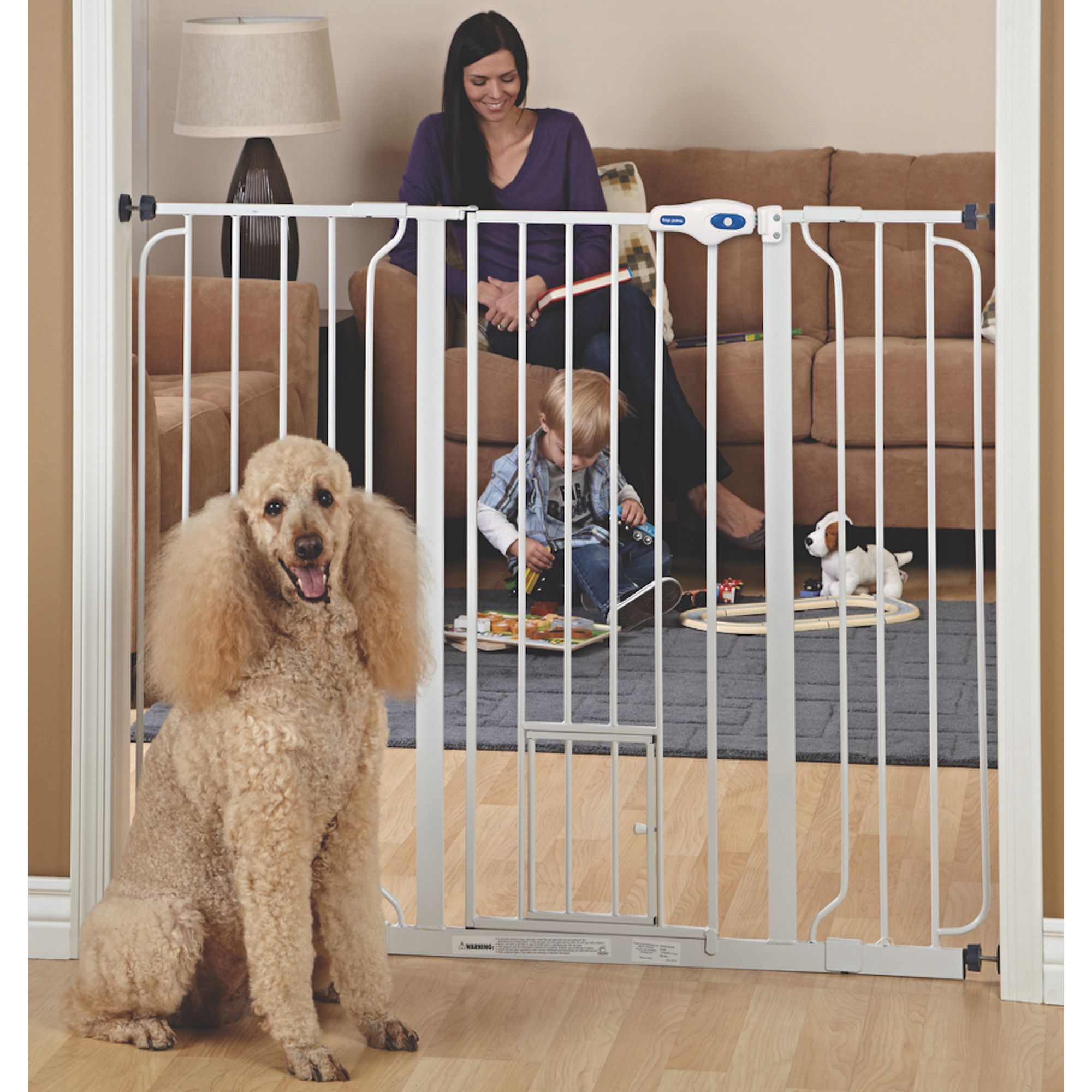
Rewarding things you want to see, and redirecting what you don’t, helps your pup make better choices.  It is OK to put the dog behind a gate, or in his kennel if you need a break. Your leash can also be a good way to help control the situation.  The goal is Safety, not Lockdown. 
 
I like to see a new dog, or a new puppy, as a furry two-year old:  You wouldn’t get mad at a two year old kid for making mistakes he isn’t aware of being “wrong.”  You’d either find something else for him to do, or stop him from killing himself, and point him off in a safer direction.
 “Nooooo no, Buddy...How about you let me have the saw blade--Where the bloomin’ hell did you even find that dude?...yeah, I know it’s cool.  But here, how about we check out this box of crayons instead?”  Same thing applies to having a puppy, or a new dog, around your children.

And lastly, please do not hesitate to contact that breeder, or call the rescue if things are not what you expected, or can handle.  It is literally Their Job to help those dogs/puppies find a suitable home that will be there for the life of the dog.  If you got your pup from a breeder or a rescue who won’t return your calls, or won’t offer the help you are seeking, start calling around.  Don’t feel like you are “Stuck” with a dog you and your household can’t handle. That is bad news for everyone. Sometimes, it just isn’t a good fit.  And Good Dog people know this. We will not judge you. We are here to help. 

Responsible breeders, and rescues, usually have a Return Clause as part of their purchase/adoption contracts.  Stating that no matter what the age, or circumstance, you can contact them and they Will take the animal back. No, it doesn’t mean you Gave Up.  It means you are enough of an adult to recognize that your family, and the dog, deserve a situation that Fits. That’s all.

Monday, December 30, 2019

The Short Walk

He needs more exercise.  


Yes.

However, if you are trying for leash-manners, that may not include a long walk.  If your walk looks like a wrestling match, or your pup is attempting to run the Iditarod with you in tow, then perhaps that is not the right kind of exercise.   There is not a lot of mental strain for a dog who isn't focusing on any behaviors that you ask of him.  He is in a reactionary state--he is simply Doing, instead of Thinking.  So how do we create a Thinker?

Begin by removing the "OH MY GAWD SHE HAS MY LEASH IN HER HAND!!!!" insanity that most dogs show you.  
They do this because every time you pick that leash up, you take him somewhere.  Pick the leash up, ignore him losing his mind, carry the leash around 'til he calms down, put the leash back on the peg...Now repeat until the dog looks at you with "Liar, we're not doing anything fun" written on his face.

Graduate to clipping the leash to  him and just letting him drag it around until he stops freaking out.  By breaking the process down in the manner, you will eventually get a dog who can Sit quietly for you to take out the leash, put it on, and now we go outside.

But before we try to go for an actual walk, maybe he needs to figure out how to follow you in the house.  Your house is boring to your dog.  I mean, we do the best we can.  We provide them with stuff to do; things to chew, treats to gain for tricks, etc, but they know every little corner.  Every smell is familiar, and there are no squirrels (wait...you have squirrels???) so it's easier to keep his focus on you. 

If you have an exceptionally wired pup, and you've gotten him to the boring stage, but every time you pick up the leash to try the next step, he loses it....that's ok.  You can either just stand there not making eye contact, and not talking to him until he relaxes, or you can drop the leash and walk away from him when he loses his mind.  I'm not at all kidding when I say that sometimes you have to break things down in to micro-bites of success for a hyper-pup.


Furniture makes great obstacles for you to walk around.  If your dog tries to get in front of you, simply go a different direction.  When you catch him in the right place--either just next to your leg with his head (not shoulders--you should be able to make both left and right turns without bumping in to him; meaning he is actually following you) reward him for being in the right place.  Treat him.  Feeding him while he is in the right position, and going the other way when he tries to lead you, starts to teach him what you want.  

"But Rose, I don't use treats.  My dog should listen to me because I am his Master.  And besides, he doesn't really like food rewards."  OK, then use LOTS of praise, and pet him on the ribcage (head can be over-stimulating) and be patient.  

Doing this leash practice in a non-stimulating environment makes this process go so quickly.  Even on a "crazy dog."  

Ok, are you ready to try this outside?  Boom! Everything you just taught him flew away and he thinks yanking you around is the thing to do. 
I watched a great video years ago (can't find it...i'm sorry) where this British trainer was teaching two insane labs to walk like polite pups on the leash.  When he reached the point of taking them outdoors, it took the yellow one more than 30 re-tries before she walked out the door at less than Mach-9.  My point is, be patient.  Very patient.  You may need to pull that pup back indoors a thousand times before they figure out the only way they are going through that door is nicely.

She got a piece of bratwurst for finally doing it right.  Tail wagging, they tried it again, and she was happily looking up at him...knowing that the reward was coming, and what was expected of her.

Shew, you made it outside.  Here's the short walk:  Do the exact same thing you taught him in your house, with the furniture.  Go up and down your driveway.  If you are doing well, maybe try two houses down, two houses back.  Use the trees.  Use the parked cars.  If you live in an apartment on the third floor, use the hallway and the stairs (be careful; stairs can be hell on canine knees) to illustrate that you are willing to do this a million times.

Ten minutes of quality walking practice in the driveway is more value for his mental stimulation, than a couple miles of reactionary out-of-control pulling you through the neighborhood.

You are going for quality over mileage.  Cuz' guess what?  You have a yard, or a long-line, that you can burn off some of that physical energy with, prior to your training session.  I suggest beginning and ending a training session with play.

Dogs live for play.  If they don't get to do fun things, they will choose what fun things they will do.  That means ignoring you.  Incorporate play into your training sessions too.  For those of you who give me the "we don't use food" I say Play More!!!  If you are using food, add Play as a supplemental reward. 
When my pup does something right, and he gets both a snack, and a chance to play with his friend (me) and we are jumping around and acting like fools together, he knows he has done the right thing for sure.  Be happy for them!  Show them they are great!  

There are exceptions to every rule.  You may try all these things and still feel like it's not working.  Contact a good Teacher and schedule a session to evaluate your unique situation.  Maybe your pup is not wearing the right piece of equipment for his individual personality.  

You may have a dog who does get over-stimulated when you incorporate excited play...that is a different conversation.

Your rescue pup may not be emotionally capable of what you are asking yet. 


Or maybe you are not physically able to jump around with him, that's OK.  There are levels of excitement that can work for everyone...you just have to be patient and figure out what works best for you and your pup.


So take those Short Walks.  

Friday, December 20, 2019

The "S" Word....

...No, not that one.
I'd like to talk about shock collars.

Now,  before y'all get righteous on me,  we aren't going to dissect how you may feel about their use in "training."  We are not going to get into whether or not you may feel they are abusive. Or if you think they're wonderful.

We are briefly going to talk about the automatic bark- control variety of these electronic collars.

We are going to simply share two things:
One;  those things pack a punch.  Most run of the mill,  bought-it-online or the-guy-at-petschmo said it was their bestseller collars are WAY too strong for your dog.

Two; very few people who strap these things to their animals read anything about what this can do to them behaviorally, or physically.

They don't follow the instructions past how to charge it, or how long you "should" leave this on your animal.

How does a long-haired coat, or a double-coat effect this tool?

Should your pet be unsupervised in this collar?

The collar itself (not the shock-box) is usually made of weather-proof, strong, plastic material, and Does Not Have a Quick Release,  or Safety Breakaway.... how many dogs are wearing these alone to chase squirrels in the backyard?

Or to wrestle with other dog friends? Have you ever witnessed a dog with its jaw hung up in another dogs collar?

Ok,  I lied... we are going to talk about a third thing.  If you aren't comfortable with gross pictures,  I suggest you read this, but do not look at the photos at the end.

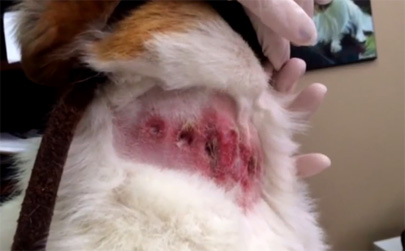
The pictures are of two different dogs, from two different families.  They were the second and third victims to come to the same hospital facility in the same week. They came in on the same day,  not even hours apart. The first dog (not pictured) was in even worse shape.

The dogs have infected wounds on their throats from bark collars.  The collars were cinched tight (cannot get good connection with the electrode points unless it is snug)  and were not checked, or removed daily.  The collars obviously did not silence these dogs, as these wounds are from electric burns.  The infection is due to the electrode points sitting on those burns for a long time.

Most likely these humans did not know the collars weren't keeping them quiet, because these dogs were most likely left alone wearing them.

In the first photo,  you will notice the dog has four burn points.  One set looks a little less gooey than the other.  This tells me the collar burn was noticed, and the box was moved and re-cinched, or the dog managed to scratch the collar hard enough to change the contact point's position at one time.

The dog not pictured? The technicians who witnessed the removal of the collar described it as an open hole with "stringy puss" as they peeled the box out of the dog's neck.

The dog pictured :  The infected area expands almost two inches in any direction around those green goo filled contact point holes.

I know life is busy.  It's Christmas for goodness sake.  You've got family in town.  Babies to put down for a nap. People and places to be at and entertain with, but seriously???

If you choose to strap a heavy electric shock to your pet,  I would hope you have shocked yourself at least once at whatever level you have set it at for your dog (not kidding,  bark collars are the worst! Ow).  

I also hope you have decided after reading this, to check that thing.  Take it off your friend for at least 12 hours a day (close the dog door if it's a barking at night problem).

Move it around every few hours,  and change the collar type to breakaway for safety (you're not supposed to clip a leash to them anyway).

Or even better, figure out why your dog is barking and start working on that.  What kind of personality does your dog have?  Is he bored?  Does he spend all day in the backyard, with nothing but barking to do?

There are so many alternatives to this method of attempting to silence your pup's annoying mouth.  Maybe reaching out to a good Professional Teacher (of the dog-specializing variety) would be a good place to start.....
*pictures are below, keep scrolling....


Banshockcollars.ca. Collar Damage
In The Doghouse DTC - THIS PHOTO WAS TAKEN BY A GROOMER COLLEAGUE JUST  RECENTLY - SHOCK COLLAR BURN!!!!! Quote "Dog smelt gawd awful, death-like,  I thought maybe it was anal glands

Thursday, January 3, 2019

Easy Peasy Ways to Entertain a Smart Dog

So you find  yourself with a smart dog.  The dog who is always "On." The dog who, for the life of you, just can't or won't settle down and just allow you to live your life.  The one who always needs all the attention:  All.  The.  Time.  So, how do you keep a guy like that from making you nuts?
It's easier than you think, but yes, it will require some intervention from you. 
1.  Join a Class.  *smile* For those of you who regularly read my articles, you know that this was bound to be on this list.  Practically every "annoying" dog problem can be helped by teaching them some new skills.  Think Agility, or Flyball, or Tracking, or Nosework, or Rally Obedience, or even a Tricks class.  These are fun, fast-paced and novel things that your dog will dig.  It may take some experimenting to figure out what he's into, but there are SO many classes out there...

2. Don't have time for a class? Totally OK!  Grab a book, or youtube some fun new things to do with your dog. 

Kyra Sundance has a great book called "101 Dog Tricks."  She also has one geared for kids and puppies called "51 Puppy Tricks."  All are Positive Reinforcement based, and are easy to follow with pictures and 'how to's.' 

Tom and Lauren have "Absolute Dogs" (all about turning obedience into games for focus!) and it's available online!

Udemy.com has some great canine courses.  Just search "Dog Trick Training" at the website.

Zac George on YouTube, has "7 tricks in 5 minutes."

Check out Training Positive on YouTube.  That kid has a whole series of safe, easy to follow videos that don't take much time to start.


3. Get a Flirt Pole.  Seriously.  If you've got a smarty pants who loves to chase things, you need one of these.  It is essentially a dog-size version of those cat toys with the stick and the string.  These toys also are a great way to teach your dog how to get crazy, then shut it off appropriately.  They pack an enormous amount of physical energy spending into not a lot of space, so if you don't have a big yard, this can still be a great way to wear out your pup. 
Squishy Face makes a reasonably priced toy, but if you've got a strong guy, you may have to swap out their basic felt braid on the end, with something a little more substantial.

4. Get Rid of Your Dog's Food Bowl.  We humans take all the natural foraging out of the equation for our dogs.  Instead of your dog spending the majority of his day foraging for scraps, or carrion, or hunting the occasional small game, we make his meals too easy--we dump it in a bowl and it gets inhaled in 3.2 seconds. 

Put the game back into his life; get a busy bowl, or a bunch of them.  Making your dog work for his meals is an easy, and much less labor intensive way to entertain his brain.  Households that choose this as the preferred feeding method tend to have calmer animals. 

If you have a multi-dog house, you may have to separate them by gates, or in different rooms in order for this not to promote fighting for the resource, but it is an easy thing to do this.  If you pup has an extra large kennel, that is appropriate for some stuffable busy toys, like a Kong, but may not be enough space for a more complicated busy toy.

5. Dog puzzles. 
Yes, some dogs figure these out in no time flat.  But maybe you just need harder puzzles. 


There are so many out there, you might just have to get creative. 
6. Exercise. Structured exercise to be precise.  You can send them to Day Care, or turn them loose at the dog park, but honestly, there are some dogs out there that can do that and still be maniacs when they come home.  This is because they are not utilizing their thinking minds as much as they are capable of.  They are in a reactive state of mind when they are running pell-mell without instruction; sure, they are having the time of their lives, but it will not truly wear them out.
                              
A structured, calm walking session, or a 20 minute training session (in addition to all that manic running around with their friends) is really the best way to get a balanced animal.

7. Hire a Hike.  Did you know there are companies out there who will pick your dog up, take them somewhere cool, keep them safe, and return them to you totally tired???  In my neck of the woods there is a great one called Waggin' Tails and Trails (www.waggintailsandtrails.com).  After an initial meet and greet, your dog will get to join his buddies in the woods and explore some of the best places Colorado has to offer a four-legger.  It's like a vacation and camp all in one.  Where this trumps the daycare option, in my opinion, is the mental stimulation he gets from exploring open spaces.  The groups are small, and his pack is not constantly fluctuating (as with the coming and going of a daycare) so he can truly enjoy his experience.

8. Play games with your dog.  My daughter plays the Cup Game with our Rockman--you know, the one where you hide something cool under one of three or five cups, and rearrange them all crazy-like, then ask the dog to find the treat?  He loves this!  I love this because it not only works on his basic manners (he has to sit, stay, wait and find), but it reinforces and strengthens their bond.
Many of my clients play Hide n' Seek with their dogs; again, teaching them to Stay while you go hide, then calling them so they can Find you.  Or have a family member or friend hold on to the dog while you go hide.

Start naming different objects and toys, and have your dog 'find' these things.  Did you know there is a Border Collie out there who knows the names of over 800 different things?  And can correctly identify them???  Your dog, who you already know is bright, is probably more cognitively capable than you can imagine.  Start putting that brain to work! 

Play Tug o' War (appropriately!!! check out http://ccanine.blogspot.com/2014/06/tools-you-didnt-know-were-tools.html for proper game protocol.)
Play Chase (he should be chasing you, not the other way around).
Play.  Just play.

9. Teach Settle or Calm.  Most of the other things on the list are geared towards physical and mental exercise, but what about the other end of the spectrum?  Your dog should also learn how to be calm, and to allow you to handle all parts of his body.  Give him a massage.   Not only does this help your relationship, it helps your dog be more comfortable in situations where he may normally lose it, or be too nervous to function.  Think Vet visit, or groomer, or say you're on a walk and he steps on a Goat-head! 

Your dog must have a grasp on how to at least Sit on cue; preferably to Down as well.  A Stand is alright, but only if he can Stay when you ask.  Begin with simple, gentle petting on all parts of him.  If there's a place he doesn't appreciate it, go slowly and more lightly, and maybe bring out some peanut butter, or cheese.  Just because you have a dog who is always "on," does not mean you can't teach him to "off" for just a few minutes.

We  have a Jack Russell/Pitbull/Whippet cross who is the basic equivalent of the energizer dog (he's almost 10 and is just now starting to act more like a dog with a 'normal' level of energy).  Teaching him to Place and to Stay, was vital (in addition to a balance of physical exercise and mental stimulation) towards us getting some peace when we were done.  Utilizing massage to encourage relaxation is a great way to get some quiet time.

10. Consider a Treadmill.  I have a handful of clients who are currently LOVING their tread-trained dogs.  This can be an excellent, quick and easy way to take the edge off a crazy kid, before you go for a walk.  A treadmill may be a lifesaver for a dog who might not enjoy the company of other dogs.  It can be a fun way to exercise your dog when it's too inclement to go outside for a long period of time, and it can be a great way to alleviate the pent up energy that can lead to your house being trashed while you're away.

If you use a positive, fun method to start this training, in no time at all your dog will grow to think this a blast. 


There are 3 basic rules for tread training:
Do Not EVER tie your dog to the mill.  He can really  harm himself this way.  We won't get into the gory details.
NEVER get out of sight of your dog on the mill.  Again, he may need your help; be there.
Do Not speed it up so that your dog is all out running.  A light trot, or an easy jog is more than sufficient.  If you want to make it a bit more difficult, put the incline up a little, not the speed.

If you are unsure what a safe amount of time for your individual dog might be, check with your vet.  Just like you would check with your own doctor before you start training for a marathon, make sure your dog is healthy enough for this kind of exercise.


11. Start a playgroup at your house.  If you have a friendly dog, but don't trust the people or other pets at the local dog park, consider a playdate at  your place, or at the home of a friend.  Check with your vet to see if they will allow you to post a "playdate wanted" flyer, or look into Rover.com  These are great ways to get some social time with your dog, and know that everyone is vaccinated and that the owners are responsible...we hope.

12. Indoor agility, and other 'creative solutions.'  There are some great basic agility sets online (or if you're creative, you can make some) that can be easy to set up and run in your house.  Having your dog 'tunnel' or jump or weave through obstacle courses is again, good for his mind and body.

Years ago, I worked with a Yorkie Terrier who seemed bored to tears with any obedience.  He'd tap out on almost anything we attempted.....until we looked in to Earth-Dog.  Earth-Dog is a sport where small dogs "go to ground" in a man-made tunnel, after a rat or other 'vermin' like creature (don't worry, no rats are harmed). 
The little dude was really into hunting, so his people built him an indoor earth-dog course, in their basement.  They also installed a short agility course, and what do you know? He was suddenly very into learning! 

13. Cater to His Breed.  I know, breed does not make up your entire dog's personality, but his genetics do play a role in what interests him.  Your terrier wants to chase vermin.  Your Aussie wants to herd stuff.  Your Retriever wants to put stuff in his mouth.  Your Hound wants to follow his nose (or his eyes, depending on the type).  You may have a mutt, and not have the slightest clue "what" he is, but playing to his strengths will go a long way towards keeping him occupied.

He can't sit still?  Try agility.
He's crazy strong?  Maybe a freight harness, and a weight-pull community.
She bolts after anything that moves?  Lure-coursing may be her thing.

The thing is, you've got to find what motivates your dog as an individual, and exploit it.  Find things he enjoys, that aren't making you nuts, and provide them to the best of your ability.  A tired dog is a good dog, but a better dog is one that you've taught the difference between Play Time and Rest Time.

Dogs are designed to work for us.  They WANT to work with us.  Our greatest failure is when we don't give them what they need...even play is a chance to 'work' in a dog's mind. 
                                                                 Let's give them that.


Friday, December 28, 2018

"He's a Rescue...."

...Is NOT an excuse for not training your dog.

Correction--That is maybe a little harsh.  How about, it is not an acceptable reason for allowing him to yank you all over the place, or jump on strangers, or incessantly bark and carry on as thought the sky is falling; especially when I hear this conversation between you and a stranger...

"Oh, he's a rescue..."
"Oh yeah?  How old is he?"
"We think 7 or so.  They didn't really know at the rescue."
"How long have you had him?"
"5 years."

Five. Years.  You have had that animal for a total of  one thousand, eight hundred and twenty-five days, and he is still acting like this?

Forgive me for a bit of a rant here.  I promise to keep it short.
Not all "rescue" dogs are damaged.   Not correcting, or not teaching them how to be civil in public, is not doing them any favors. 

There are legitimate cases where the most compassionate, and appropriate advise is to back off and allow the dog time to realize you are not there to abuse him.  There are dogs with such fear or shyness, they literally become overwhelmed and cannot function until they have rebuilt Trust in the humans around them.  There is a period of time in which you really do need to allow a "rescue" to adjust.  At some point, these shy guys turn a corner, and start to come out of their shell--they start to show you who they are.  It varies among them, as they are all individuals, but there is no excuse, in my opinion, for allowing an animal to run wild because your soft heart thinks he will hate you for correction.

On the contrary, he will only love you more if you can put your foot down, and teach him what is and isn't appropriate.  Dogs need leaders.  They are not comfortable, or relaxed, or truly happy until they can understand their place in their "pack."  Your household, and those  living in it, constitute that social hierarchy.  When you allow him to act like a giant idiot, he is getting the impression that you are not in control, therefore he feels like he needs to be.  But most dogs (and I know you have heard me say this before) make Absolutely TERRIBLE leaders.

I am not suggesting that you don a uniform and adopt a "surrender or die" approach, and over-dominate your friend.  But there is a need for leadership. 
Trust me, not only will he appreciate it, everyone around you will too.